
How to Replace a Mechanical Pump Seal for Rotating Equipment
Installation Guide
How to Replace a Mechanical Pump Seal
Remove the old seal, install the new one, and start the pump back up without leaks — a plain-English guide for pump-shop techs and DIY pump owners.

Learn how to replace a mechanical pump seal the right way — how to remove the old seal, install the new one, and start the pump back up without leaks. This guide is written in plain language for both pump-shop techs and homeowners replacing a pool or spa pump seal themselves.
To replace a mechanical pump seal, you disassemble the wet end of the pump, remove the old rotary and stationary seat, clean the shaft and seal chamber, lightly lubricate and press in the new seat, slide on the new rotary, reassemble the pump, and prime it before startup. The two rules that matter most: never touch the polished seal faces with bare fingers or tools, and never run the pump dry.
This guide is for anyone searching how to replace a mechanical pump seal, shaft seal replacement, pump seal replacement, how to install a mechanical seal, or why a pump leaks after replacing the seal. It covers conventional single-spring and bellows-style seals found in most water, pool, spa, booster, and circulator pumps.
New to this? Don't worry — if you can take the wet end of your pump apart and keep two parts clean, you can do this. Read the “Parts of a Mechanical Seal” section first so the steps make sense.
If you need a replacement seal after reading this, browse our mechanical seals or contact us and we'll help match the right seal for your pump.
Quick Reference
- Take the pump apart and remove the old seal
- Clean the shaft and seal chamber
- Lubricate the rubber parts with P-80 — never the faces
- Press in the new stationary seat, squarely
- Clean the faces with alcohol and install the rotary
- Reassemble with a new gasket & O-rings, then prime before startup — never run dry
Quick Answers
Can I replace a mechanical pump seal myself?
Yes. Replacing a pump seal is a common DIY repair, especially on pool and spa pumps. The job is mostly about cleanliness and patience — keeping the polished faces spotless and installing the new seal the same way the old one came out.
What is the most important rule when installing a mechanical seal?
Try not to touch the two polished sealing faces with your fingers or any tool, and never run the pump dry. A fingerprint, a scratch, or a few seconds of dry running can ruin a brand-new seal. If touched clean with alcohol or other solvent to remove impurities
Why does a pump leak after replacing the seal?
The most common causes are a fingerprinted or scratched seal face, the seat not pressed in squarely, the wrong size seal, or the pump being run dry at startup.
Parts of a Mechanical Seal
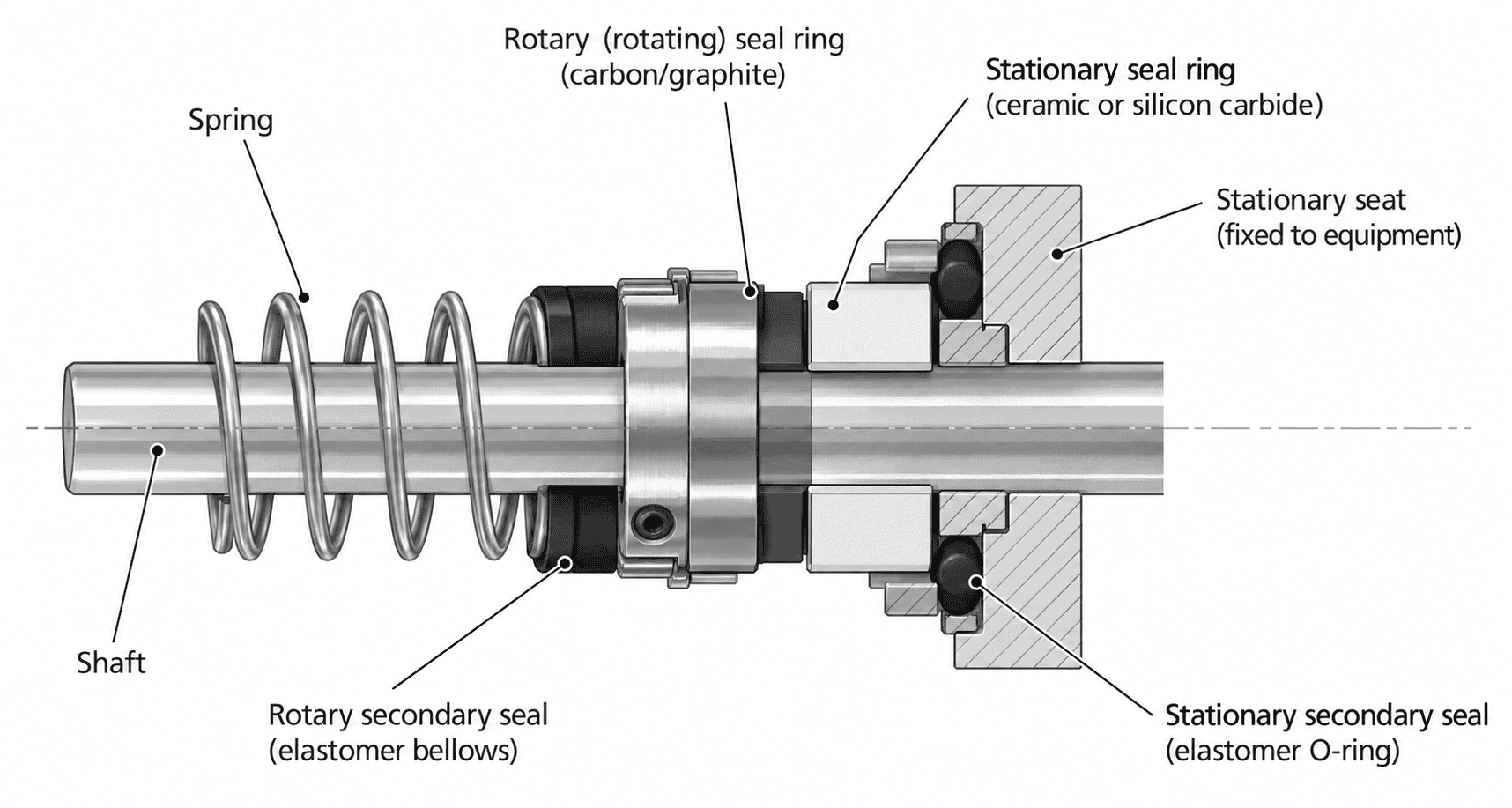
A standard mechanical seal comes in two halves that run against each other to keep water from leaking down the shaft:
- Rotary (spring half): Rides on and spins with the shaft. It has a secondary seal on the shaft, typically where spring or springs are located, lapped and a polished sealing face.
- Stationary seat: Press-fits into the pump's seal chamber and stays still. It also has a polished face, usually ceramic.
- Lapped (polished) faces: The two mirror-smooth surfaces that press together. This is the actual seal — and the part you must never touch or scratch It is what makes a mechanical seal. It is two specific materials that use a microscopic film of the pumped fluid to lubricate them, the width of around 1/30 of a human hair is the amount of fluid between the faces when an application is running.
- Seal chamber / stuffing box: The area which a mechanical seal is typically fitted. Internally or bolted externally to the face.
Tools & Materials You'll Need
- The correct replacement mechanical seal for your pump
- Basic hand tools to take the pump wet end apart
- Fine emery cloth
- Clean, lint-free cloths or tissue
- Isopropyl alcohol (or a similar solvent) to clean the faces
- P-80 emulsion rubber lubricant (to ease the rubber parts into place)
- Calipers, if you want to confirm the new seal matches the old one
- A new gasket and O-rings for the pump (highly recommended while you're in there)
- Cut the power. Disconnect and lock out power to the pump motor before you touch anything.
- Relieve pressure and drain. Make sure the pump is not pressurized and the water is drained.
- Protect the faces. Keep the new seal in its packaging until you're ready, and only handle the faces by their edges with clean hands.
- Have alcohol ready. You'll wipe both polished faces with alcohol right before they mate.
- Confirm everything is reassembled and fasteners are tight.
- Prime the pump so it's full of water. On self-priming pumps, fill the casing first.
- Open all valves so the pump runs free-flowing. Never start the pump against a closed valve (this is called dead-heading and it builds damaging heat).
- Start the pump and watch closely for leaks, noise, vibration, or heat for the first few minutes.
- ISO 9001:2015-certified manufacturing sources — seals built to spec.
- Mechanical seals, pump repair kits, gaskets, O-rings & packing in stock.
- Ships fast from our Delray Beach, Florida warehouse.
- Real seal specialists with 25+ years in rotating equipment — call or text 561-414-1046 for part matching.
Before You Start
How to Replace a Mechanical Pump Seal (Step by Step)
Take the pump apart and remove the old seal
Following your pump's manual, separate the motor/seal plate from the pump body and remove the impeller to expose the seal. Take out both halves of the old seal — the rotary that rode on the shaft and the stationary seat in the seal chamber. Work gently so you don't scratch the shaft or the bore. Before you toss the old parts, note exactly how they were oriented (which way the spring and the polished face pointed) so the new seal goes in the same way. If you have calipers, measure the old seal and the bore and compare them to the new seal to confirm the fit.
Clean the shaft and seal chamber
Wipe down the shaft and the seal chamber. Use fine emery cloth to remove any scale, rust, debris, or burrs, then wipe everything clean. Be careful not to sand a flat spot into the shaft or change its round shape — the new seal needs a smooth, round, clean surface to seal against.
Lubricate the rubber parts (never the faces)
Lightly lubricate only the rubber parts of the new seal so they slide into place without tearing — the rubber inside the rotary and the rubber boot or O-ring on the outside of the stationary seat. Use P-80 rubber lubricant; it's water-soluble and safe on rubber. (A rubber-compatible grease may be used on seals that do not have an anti-slip drive band, but when in doubt, use P-80.) IMPORTANT: Never put oil, grease, or P-80 on the polished seal faces. The faces must stay perfectly clean and dry, or the seal will leak.
Press in the stationary seat
Press the stationary seat squarely into the seal chamber. You can usually push it in by hand or with light, even pressure. Protect the polished face — place a clean tissue between the face and any tool, and never push on the face with bare metal. Make sure the seat goes in straight and seats all the way. On seats with an O-ring, the polished face points outward toward the rotary; if the seat has a locating pin, line it up with its slot.
Clean the faces and install the rotary
Wipe both polished faces with alcohol on a clean, lint-free cloth right before they mate — even a fingerprint can cause a leak. Then slide the rotary down the shaft until its face meets the seat's face, keeping it square and parallel. Don't roll or pinch the rubber bellows as it slides on. Check that the spring is seated correctly against the shoulder of the seal and the impeller (or shaft retainer). If your seal uses a separate locking collar, set it so the seal is compressed to its correct operating length.
Reassemble and turn by hand
Reinstall the impeller, a new gasket/O-rings, and the pump housing. Before you apply power, turn the shaft by hand — it should spin freely. If it binds or feels rough, take it back apart and check your work before going further.
Startup Procedure
How you start the pump matters as much as how you installed the seal. Most new-seal leaks and overheating happen in the first few minutes.
IMPORTANT: Never run the pump dry. Running dry — even briefly — can destroy a new seal's faces in seconds. Always prime first, keep all valves open, and make sure the pump stays flooded with water.
Special Applications (Vertical & Cartridge Pumps)
On a vertical pump or a cartridge-style seal — such as a deep well pump — we recommend running a small line from the discharge side to the seal's flush port. This circulates water across the seal faces to keep them cool and prevent heat buildup, which is a common cause of early seal failure in these applications.
Don't Skip the Gasket & O-Rings
Here's the mistake that sends people right back into their pump: they install a perfect new mechanical seal, then bolt the housing back together on the old, hardened gasket and brittle O-rings. The shaft stops leaking — but now it weeps at the housing joint, and the pump has to come apart all over again.
The gasket and O-rings are the cheapest parts in the entire job and the easiest to overlook. A fresh housing/volute gasket compresses evenly for a clean, leak-tight seat, and new O-rings keep the seal chamber and fasteners sealed. Any time you replace a mechanical seal, replace the gasket and O-rings at the same time. It's a few dollars of insurance against a second teardown.
Seal House stocks pre-cut gaskets for popular pump brands — Goulds, Sta-rite, Berkeley, Flint & Walling, Aermotor, SPX and more — plus red rubber, neoprene, and vellumoid gasket material by the sheet for custom cuts.
Why a Pump Leaks After a New Seal
If your pump still leaks or runs hot after a seal replacement, use this chart to find the likely cause.
| Symptom | Likely Cause | What to Do |
|---|---|---|
| Leaks right after startup | Fingerprint, oil, or scratch on a seal face | Remove the seal, clean both faces with alcohol, or replace if scratched |
| Leaks right after startup | Stationary seat not pressed in squarely | Re-press the seat fully and square to the bore |
| Leaks right after startup | Wrong size or wrong seal for the pump | Verify the seal matches your pump and shaft size |
| Leaks during operation | Rubber bellows rolled or pinched on install | Reinstall the rotary without rolling the bellows |
| Seal runs hot / fails quickly | Pump run dry or dead-headed | Prime the pump, open all valves, keep it flooded |
| Leaks during operation | Worn shaft, bearings, or excessive vibration | Inspect and repair the pump's mechanical condition |
| Still weeping after a day | Old gasket or O-rings reused | Replace the pump gasket and O-rings |
Choosing the Right Replacement Seal
The most reliable way to get the right part is to match it to your pump's make and model, or to measure the old seal (shaft diameter and overall dimensions). The seal's face and elastomer materials should also suit your fluid and temperature — see our guide to choosing the right seal material.
One tip from our shop: when a pump is leaking, the mechanical seal is usually the culprit — but it's worth replacing the gasket and O-rings at the same time. They're inexpensive and save you from opening the pump again next month.
We'll match the right seal, kit, or gasket to your pump — ships fast from Florida.
Why Buy From Seal House USA
Frequently Asked Questions
How do I know if my pump seal is bad?
The most common sign is water dripping or spraying from between the motor and the pump body (the seal area). On pool pumps you may see water under the motor or a puddle after it shuts off. Water in the motor's oil or rust streaks down the housing are also signs.
Can I replace a pool pump seal myself?
Yes. Pool and spa pump seals are one of the most common DIY seal replacements. Follow the steps above, keep the faces clean, and make sure the pump is primed before you start it.
What lubricant should I use to install a mechanical seal?
Use P-80 rubber lubricant on the rubber parts to help them slide into place. Never put any lubricant on the polished seal faces — they must stay clean and dry.
Which way does the seal face go?
The two polished faces always go together, face-to-face. The stationary seat's polished face points out of the seal chamber toward the rotary's polished face. When in doubt, install the new seal the same way the old one came out.
Do I need to replace the gasket and O-rings too?
It's strongly recommended. While the pump is open, new gaskets and O-rings are cheap insurance against a repeat leak from a part you didn't replace. We stock pre-cut gaskets and gasket material for most popular pump brands.
Can a mechanical seal run dry?
No. Dry running is one of the fastest ways to destroy a mechanical seal. Always prime the pump and keep it flooded with water.
Why is my pump still leaking after I replaced the seal?
Usually a contaminated or scratched face, a seat that isn't seated squarely, a rolled bellows, the wrong seal, or running the pump dry. See the troubleshooting chart above.
How long should a mechanical seal last?
With correct installation and no dry running, a quality mechanical seal can last for years. Most early failures trace back to installation mistakes or running the pump dry.
How long does it take to replace a mechanical pump seal?
For most small pumps, an experienced tech can replace a mechanical seal in about 30 to 60 minutes. First-timers should budget a couple of hours and work slowly — rushing the faces is what causes leaks.
What are the signs of a bad mechanical seal?
Water dripping or spraying from between the motor and pump, puddles under the pump after it shuts off, a squealing or chirping noise at startup, or water mixing into the motor oil are all signs the mechanical seal is failing.
Can I just replace the seal, or do I need a new pump?
In almost all cases you replace just the mechanical seal (plus the gasket and O-rings) — not the whole pump. A new seal is a fraction of the cost of a new pump and restores the leak-tight shaft.
How often should a pump seal be replaced?
There's no fixed schedule — replace the seal when it starts to leak or when you rebuild the pump. Running dry, dead-heading, or abrasive water shorten seal life, so address those to make seals last longer.
What is the difference between a shaft seal and a mechanical seal?
On pumps the terms are often used interchangeably. "Shaft seal" describes where it seals (around the rotating shaft), and "mechanical seal" describes how it seals (two lapped faces held together). The replacement process in this guide applies to both.